
SLAB-RS, Part 8: The Word the Embeddings Couldn’t Read
Published:
Part 7 ended on a hard verdict: the classical retail-search toolkit was measured end to end, and almost none of it earned its place. But almost none is not none. One component shipped in Phase 3, and it is the most interesting result of the phase — because it did not come from a bigger model, a training pipeline, or more data. It came from reading the failures.
The phase opened with a funny one. A search for chikko — a misspelling — was returning coffee, and the hybrid seemed to quietly fix it. Encouraging. But “seemed to” is not a number, so the agent stopped trusting the anecdote and measured a thousand queries. The fuller truth was less flattering, and much more useful.
The Short Version
The agent built a failure taxonomy: it took 1,000 queries that each have a known-correct Exact product, and asked a precise question — when the right answer exists, how often does the system fail to rank it first, and why?
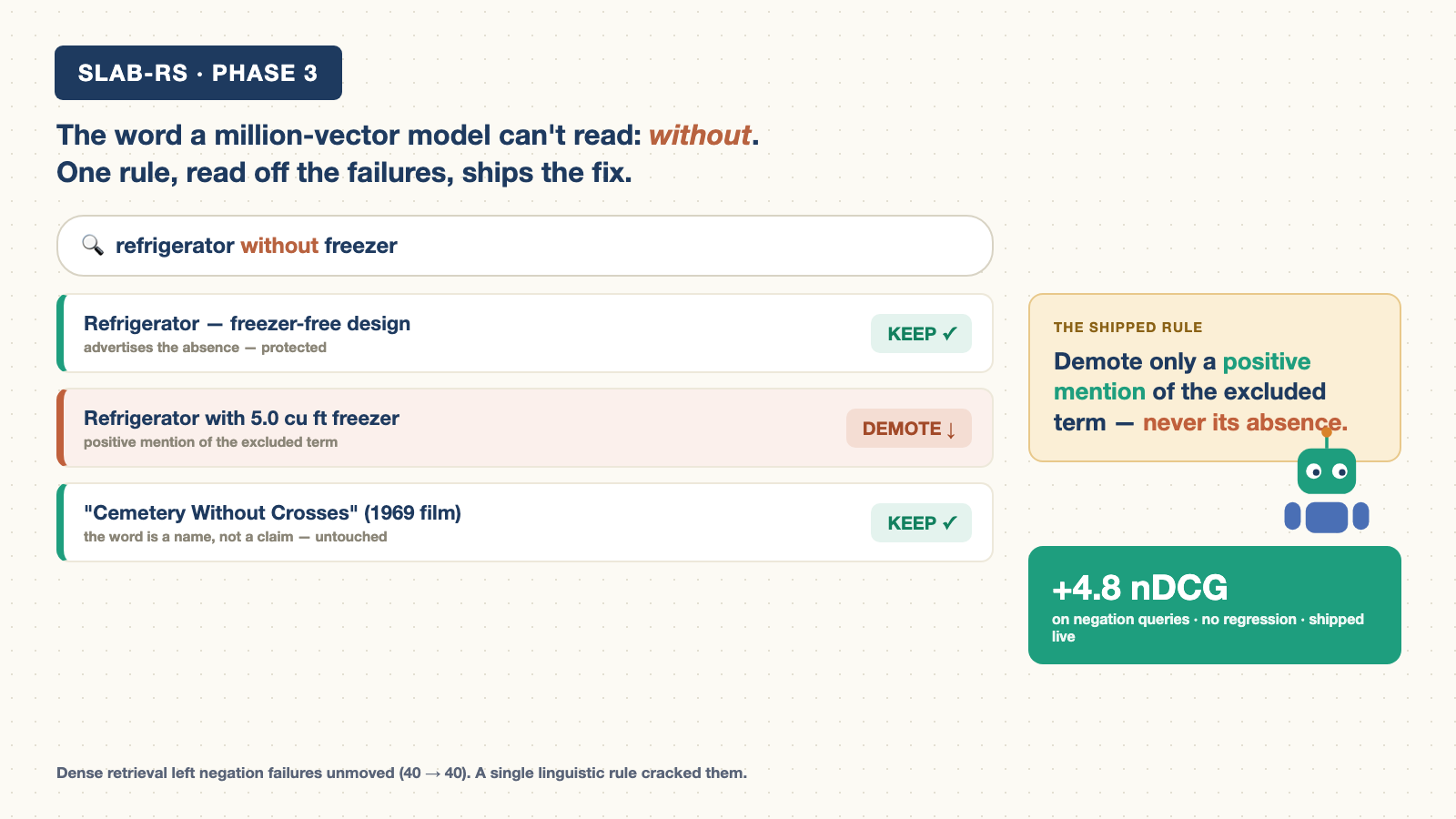
That taxonomy exposed a residual the million-vector embedding model could not touch: negation. Queries like refrigerator without freezer failed just as often with dense retrieval as without it — because an embedding model does not encode the word without. The fix was not a bigger model. It was a single linguistic rule, and it shipped: +4.8 nDCG on negation queries, no regression, live.
And the counterpoint that proves the discipline: a second, similar fix for attribute constraints was measured and deliberately not shipped, because the taxonomy predicted — correctly — that it had almost no headroom left.
Reading a Thousand Failures
Most retrieval evaluation reports one aggregate number. A failure taxonomy asks a sharper question, and it needs provable failures to be honest — cases where you can prove the system got it wrong because a correct answer demonstrably existed and was not ranked first.
Across the 1,000 queries that have an Exact match,1 plain BM25 fails to rank that Exact first 37.2% of the time (372 queries). The hybrid brings that to 30.4% (304). But the interesting part is what kind of failure each one is:
| Failure type | BM25 top-1 misses | After hybrid |
|---|---|---|
| A substitute outranks the exact | 197 | 163 |
| A complement/irrelevant outranks it | 122 | 95 |
| Brand mismatch | 13 | 6 |
| Intent / negation | 40 | 40 |
Read that last row twice. Every other category improved when dense retrieval was added — brand mismatch was nearly eliminated, substitutes were cut. Negation did not move at all. Forty failures before, forty after. And underneath the flat total, it was not stable — the hybrid fixed 5 negation queries and broke 5 others. That is not improvement. That is a coin toss. The single most powerful technique in the entire project — dense embeddings, the thing that broke every ceiling from Cranfield to a million products — is blind to negation.
Why the Obvious Fix Is Wrong Twice
The obvious reaction to refrigerator without freezer is a must_not filter: exclude any product whose text contains “freezer.” It is wrong, and it is wrong in two different directions.
Trap one: the word is part of a name. “Without” often appears in product titles that have nothing to do with a constraint — Cemetery Without Crosses (a film), a book, a band’s album. A must_not on the excluded term throws these out for containing their own title.
Trap two: the correct product advertises the absence. The single best answer to “refrigerator without freezer” is often a product whose description literally says “no freezer compartment” or “freezer-free design.” A filter that removes anything mentioning “freezer” deletes exactly the product the shopper wanted, because it named the very thing it lacks.
So a naive filter fails the movie and the freezer-free fridge — the two populations negation splits into. An embedding model, meanwhile, sees “refrigerator” and “freezer” as highly related words and cheerfully returns fridges with freezers. Neither scale nor a filter solves this. It needs to be read.
The Rule the Agent Shipped
The fix is one observation stated as a rule: demote a product only when it makes a positive mention of the excluded term — not a mention of its absence.
A fridge whose description says “spacious freezer” is a positive mention of “freezer” → demote it. A fridge that says “no freezer” or “freezer-free” is a mention of the term’s absence → protect it. A film called Cemetery Without Crosses never positively asserts the excluded attribute at all → untouched. One rule, both traps closed.
On the 61 real negation queries in the set, it moved nDCG2 from 0.7784 to 0.8267 — up 4.8 points — and fixed 10 of the 28 top-1 failures, with no regression elsewhere. It costs nothing at query time and needs no model. It shipped to production, and it is the “hybrid + negation” row that sat at 0.8528 in Part 7’s scoreboard — the lean stack the full training cascade could only beat by a tenth of a percent.
You can watch it work: refrigerator without freezer — freezer-equipped units drop, and the “without freezer” products hold their place.
The Fix the Agent Refused to Ship
Here is the part that makes it a discipline and not a lucky guess. Negation has a sibling: attribute constraints, like a color or a size that must match. The agent built the same kind of reranker for attribute conflicts and measured it exactly the same way.
On its own 44-query subset it looked fine — nDCG 0.8679 to 0.8855. But across the full thousand queries the effect was +0.0008, and it fixed exactly one of eleven top-1 failures. The taxonomy had already predicted this: attribute failures were a small, mostly-handled category. So it was not shipped. The measurement existed only to answer “is this worth building?” — and the honest answer was no.
That is the whole method in one contrast. Two nearly identical fixes, built and measured the same way. One found a residual nothing else could touch and shipped. The other confirmed there was no residual left and was set aside. The taxonomy is what told them apart before either became a maintenance burden.
The Point
Phase 3’s biggest, most portable win was a million-vector embedding model. Its last, shipped win was a single sentence about the word without — something that model, for all its scale, does not encode. The residual that survived more data and more model fell to reading the data.
That is where structural query understanding earns its keep: not as a layer you add because the textbook says so (the textbook cost more than it returned), but at the exact point where a bigger model stops helping and a human observation starts. You find that point by measuring failures, not by measuring averages.
Closing Phase 3
Three articles, one arc. Part 6: the academic stack transferred to a million real products at production latency — parity, on a free-tier box. Part 7: the full classical toolkit was the ceiling, and not worth its cost. Part 8: the one thing worth shipping came from understanding a failure, not adding scale.
What Phase 3 ships is exactly that lean: BM25 + a BGE hybrid + one negation rule, all inside 700 ms on one small box. Everything else was measured, mapped, and left on the shelf with its evidence attached.
Phase 4 is where the last thing academic data cannot provide arrives: customers. Clicks, add-to-cart, purchases — the only signal that separates a search engine that is technically correct from one that actually sells. That is where the learning-to-rank infrastructure kept in the portfolio, dormant since Phase 2, may finally get the signal it was built for.
Takeaways
- Measure failures, not just averages. The aggregate nDCG hid the fact that dense retrieval does nothing for negation. A per-category failure taxonomy is what surfaced the one residual worth fixing.
- Some meaning is not in the vectors. A retrieval-tuned embedding model that beat every benchmark still cannot read the word “without.” Scale did not close that gap; a rule did.
- The obvious fix can be wrong in two directions at once. A
must_notfilter on negation kills both product names and products that advertise the absence. The correct rule demotes only a positive mention of the excluded term. - Knowing what not to build is the return on measuring. The attribute reranker worked on its own subset and was still correctly refused, because the taxonomy showed it had no headroom. That refusal is the discipline, not a failure of it.
Phase 1 proved the method. Phase 2 found out what it learned. Phase 3 took it to real products — and the last word belonged not to the biggest model in the stack, but to a careful reading of where it broke.
References
Reproduction figures are measured on this project’s own free-tier stack, over the 1,000-query ESCI evaluation subsample. Phase 3 experiment artifacts and the architecture ledger are public in the project repository.
Reddy, C. K., Màrquez, L., Valero, F., Rao, N., Zaragoza, H., Bandyopadhyay, S., Biswas, A., Xing, A., & Subbian, K. (2022). Shopping Queries Dataset: A Large-Scale ESCI Benchmark for Improving Product Search. arXiv:2206.06588. Source of the products, the graded Exact/Substitute/Complement/Irrelevant labels, and the query set the failure taxonomy is built on. ↩
Järvelin, K., & Kekäläinen, J. (2002). Cumulated gain-based evaluation of IR techniques. ACM Transactions on Information Systems, 20(4), 422–446. nDCG@10 with the ESCI graded gain mapping is the metric throughout; all comparisons are on the 1,000-query evaluation subsample. ↩