
Part 4: E-commerce Alert: AI Shoppers Read Reviews, Not Your Store
Published:
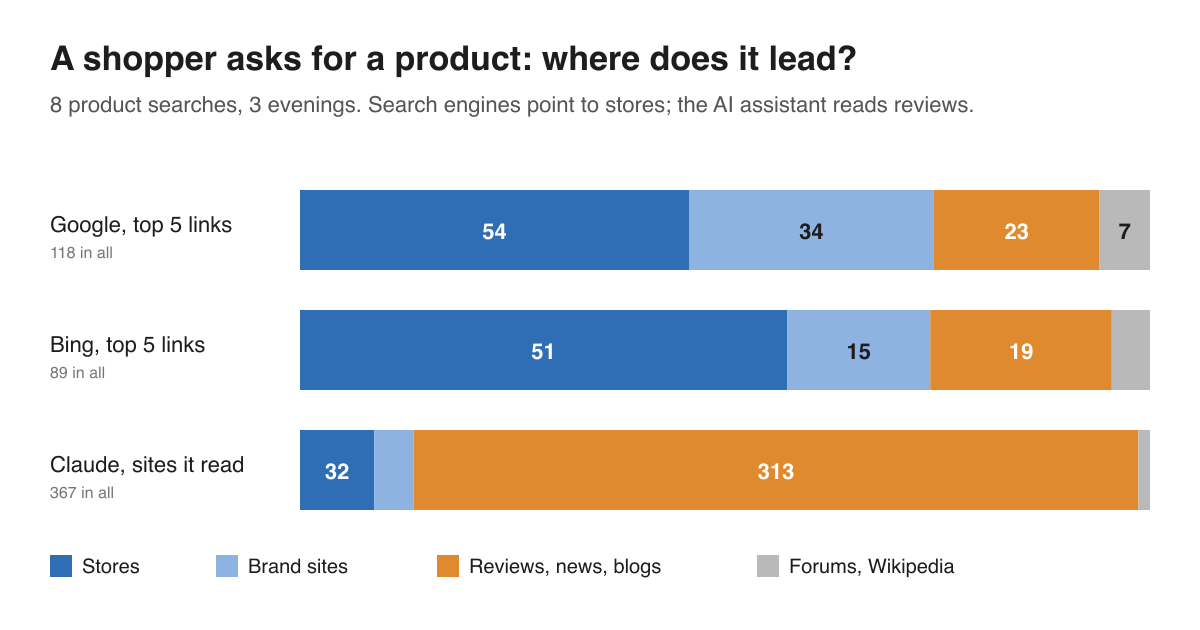
Where a shopper's product question leads. The search engines' blue links point to stores; the AI assistant reads reviews. Eight product searches, three evenings, November 2026.
A new shop window
If you sell online, your shop window has been a page of search results for twenty years, with Amazon the store to beat. Shoppers are starting to ask an AI assistant instead, and agents that research, compare and buy for them are being built. When a shopper asks for a product, where does it lead today?
In Part 2 and Part 3 I asked for someone to hire. This time, something to buy: eight plain product searches, “air fryer” to “cordless drill”, plus “tires near me”, in Google, Bing and Claude on three evenings. ChatGPT was not captured; it comes later.
Today: two answers
The search engines answer “where can I buy this?” Of Google’s 118 top-five blue links, 54 were stores and 34 more were the maker’s own site. Bing showed fewer links; 51 of its 89 were stores. Amazon was in Google’s top five on 18 of 24 pages, and Google kept the same #1 all three evenings for seven of eight searches.
| Search | Google #1 (all three evenings) | Amazon in Google’s top 5 | Amazon in Bing’s top 5 |
|---|---|---|---|
| nintendo switch 2 | nintendo.com | 0 of 3 | 0 of 3 |
| air fryer | amazon.com | 3 of 3 | 3 of 3 |
| mattress | changed (Walmart, then Mattress Firm) | 1 of 3 | 2 of 3 |
| water filter for lg refrigerator | lg.com | 3 of 3 | 0 of 3 |
| cat litter | chewy.com | 3 of 3 | 3 of 3 |
| 65 inch tv | walmart.com | 3 of 3 | 0 of 3 |
| cordless drill | amazon.com | 3 of 3 | 2 of 3 |
| best cordless drill | consumerreports.org | 2 of 3 | 0 of 3 |
One word changes the page. “Cordless drill” opens with Amazon; “best cordless drill” opens with Consumer Reports every evening. Ask for a thing, you get stores. Ask for a judgement, you get reviewers.
The AI assistant answers “what should I buy?” Claude searched the web in 40 of its 72 answers. When it did, it read reviewers: of the 367 sites it read, counted once per answer, 313 were review, news or blog sites and 32 were stores. It never opened a page on Amazon, Walmart, Best Buy or Costco, and named a store, or the maker’s own shop, in 20 of 72 answers.
It named products instead: 16 TV models across nine “65 inch tv” answers, an LG and a TCL in every one and a store in only one; 27 drills for “best cordless drill”, none in all nine. For “mattress” and “cat litter” it never searched and named no product, only a buying guide and a question back.
They barely read the same pages. On the 15 search-evenings when Claude searched, its sources matched a Google top-five link 22 times out of 183, and a Bing link 10 times. Local is the exception: for “tires near me” Claude listed tire shops every time and each evening read four or five of Google’s top five.
What changes when agents shop
Opinion follows, reasoned from the data about a future I did not test.
Today the assistant stops at advice; the shopper still clicks through to a store. An agent would check out too. If it researches the way Claude did:
- Reviews become the shelf. Claude’s picks came from reviewers; an agent reading the same sources may never shortlist a product none of them covered.
- The store link stops being the default. Claude chose the product first and rarely named a store; a store ranking may count for less when an agent, not a person, reads it.
- Being recommended is a second job. A store visible on Google can be absent from an answer built from reviewers.
- Local may change least. For tires, the assistant and Google read much the same pages.
I would not tell a store to drop SEO on one small test. But ranking on Google and being recommended by an assistant are now two different jobs, and the second may soon decide what an agent buys.
How I measured
Three evenings, 4, 5 and 6 November 2026, about 24 hours apart, one laptop near Marietta, Georgia. Google and Bing: signed out, one page per search per evening, blue links only, not the sponsored product carousels filling much of each page; Bing often showed fewer than five. Claude: Anthropic’s API with web search on, three fresh requests per search per evening, 81 answers; only the tires search carried a location. Categories are my own sorting; model variants were merged. Eight searches show a direction, not a law. No local business is named; no percentages.
What’s next
The companies behind the assistants, OpenAI and Anthropic among them, are building tools to join the e-commerce race. Part 5 looks at those tools and what they mean for anyone selling online.