
Part 2: Google Picked One Plumber. ChatGPT Picked Another.
Published:
The short version
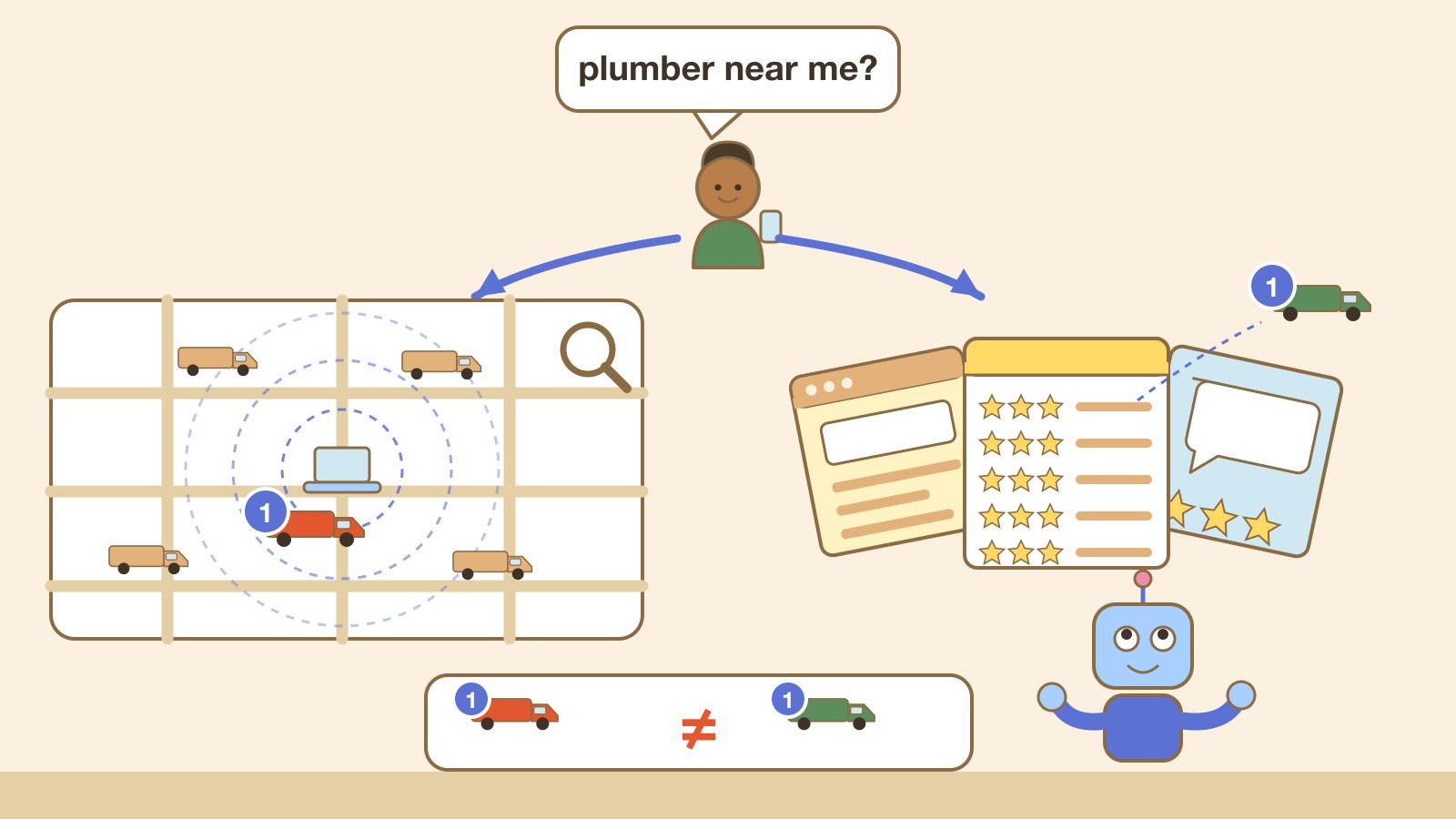
Three evenings in a row I asked Google for a plumber near me, then asked ChatGPT the same thing. Google’s first pick never appeared in ChatGPT’s answer. Not second, not fifth — not at all.
I did the same for eight trades — plumber, electrician, roofer, dentist and four more — on Google, Bing, ChatGPT and Claude. The business Google put first on its map was never the one ChatGPT named first, and usually was not in either assistant’s answer at all. What little agreement there was came partly from businesses paying Google for the top spot.
And the tool I expected to be flaky — the chatbot — gave me a steadier list from one evening to the next than Google’s map did.
Being easy to find is no longer one job. It is two.
One measures distance. The other reads the internet.
A search engine knows where you are. Your laptop hands over a location, and the map results are ranked partly by how close each business sits to that point — Google says so itself: relevance, distance, popularity.
An assistant gets nothing that precise. ChatGPT said so itself, in its very first answer: “Your exact location isn’t available to me, so these are Marietta-area options.” It settles on a town, quietly rewrites your question — “plumber near me” becomes “plumber in Marietta, Georgia” — and then goes reading the pages you would find yourself: the “10 best plumbers in town” lists, review sites, directories, company websites.
These are not two versions of the same tool. One measures distance. The other reads what the internet says about you.
One detail stuck with me. My laptop sat in the same place all three evenings. Google decided I was in one town, Bing in another, and both were wrong. ChatGPT, with no precise location at all, had the town right.
Position 3 is not a thing you can hold
When you rank on Google you hold a slot. Position 3 is something you can own, lose, and pay to defend. Every SEO invoice is ultimately about a slot.
The assistants do not work that way. ChatGPT gave me a numbered list every time, but the order is its own writing, not a position in an index. Claude mostly did not number anything: it grouped businesses by what they are good at, or put them in a table. There is no slot to hold, because there is no page to hold it on.
The part that surprised me
I expected the AI answers to be the flaky ones — a different list every time you ask. The opposite happened: the map pack moved around between evenings more than the chatbot did.
Three evenings is not a study of the internet. It is enough to tell me the comfortable assumption — search is dependable, AI is unpredictable — is not safe to repeat.
So what should a business actually do?
Two jobs, not one.
For the map results: your location details have to be right and complete — address, hours, categories, reviews, verification. This is the old work, and it still decides the map.
For the assistants: you have to exist convincingly on the pages they read — the directory lists, the review sites, and your own website saying plainly what you do and where. If the “best plumbers in your town” page does not mention you, the assistant has no reason to either.
Neither covers for the other. Do only the first and the chat may never mention you; only the second and the map will not show you.
Next: the same question, about products
A service call ends in a phone number. A product ends in a cart.
Next week I am running a version of this experiment with Akanksha, on product ranking — what happens when you ask an assistant to find something to buy rather than someone to hire. If one question about a plumber gives four answers, what happens when there is a checkout at the end of it?
How I ran this, and what I am not claiming
Eight questions — plumber, electrician, HVAC repair, roofing contractor, pest control, landscaping, auto repair and dentist, each as “… near me” — three evenings roughly 24 hours apart, one laptop in Marietta, Georgia. Google and Bing captured from the browser; Claude through its API, which I told the town up front because it has no other way to know; ChatGPT in fresh temporary chats with search on, told nothing. Part 1 explains why I am running these.
I am deliberately not publishing percentages: eight questions over three evenings can show a direction, not a magnitude, and a precise-looking number would be worse than none.