
From Code Generation to Application Generation, Part 7: How Mission-Driven Engineering Happened
Published:
This article continues my series on building applications using AI.
In the last article, I introduced Mission-Driven Engineering, or MDE. The core idea is simple: the mission should be the primary artifact, not the code, UI, database schema, or application model.
The Short Version
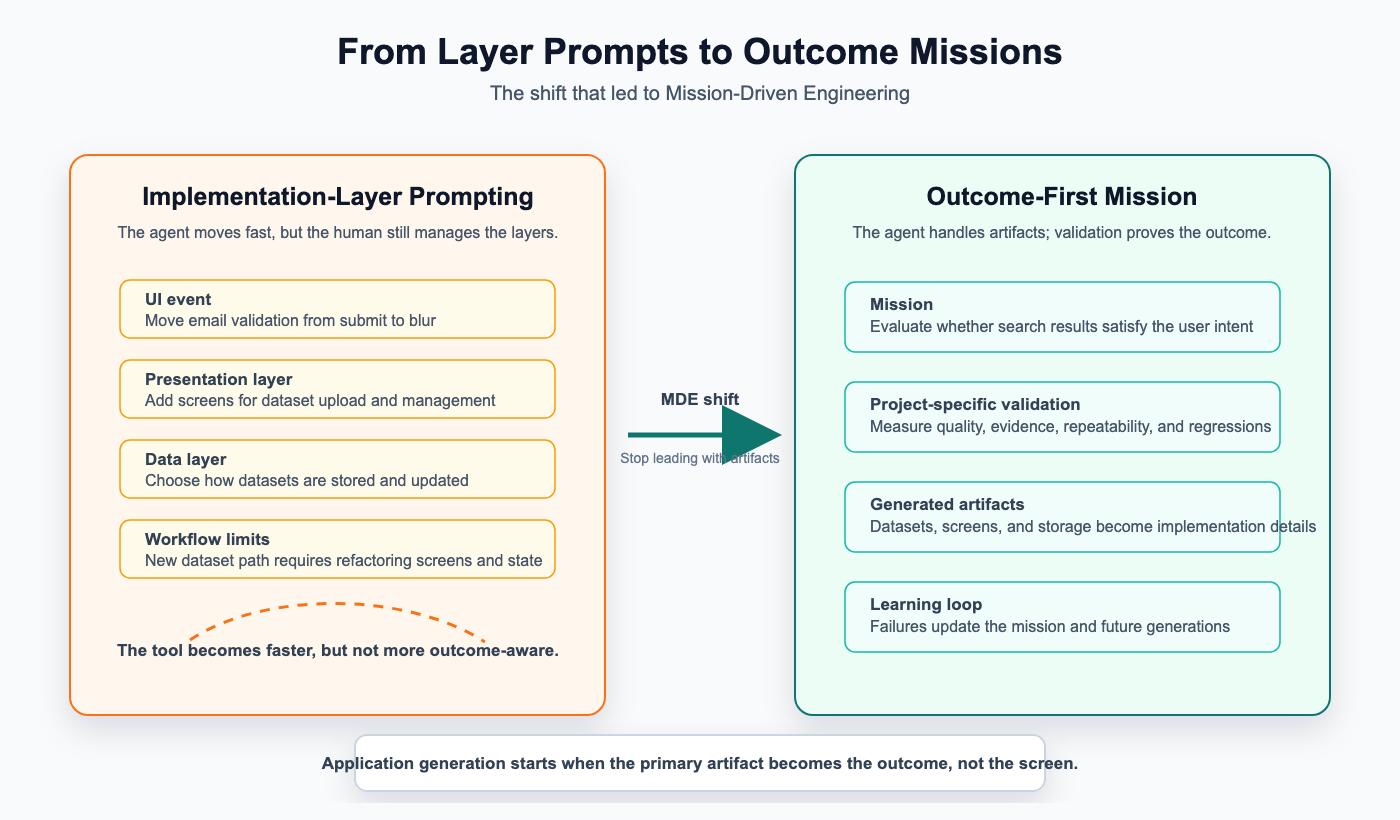
Mission-Driven Engineering happened because I realized I was using AI coding agents to move faster through the same old implementation layers: screens, forms, data models, validation behavior, upload flows, and storage decisions.
The agent made that faster, but not more outcome-focused. The real question became:
Why am I managing all these intermediate artifacts if the thing I care about is the final result?
The Project That Exposed The Problem
The project was a search evaluation platform, something I had wanted to build for years. I wanted to evaluate whether a search API returned good results and make search quality evaluation repeatable.
With coding agents, implementation finally moved fast enough to keep up with my thinking. Then I fell back into old habits and started asking for implementation changes:
On the admin management screen, email validation currently happens on submit. Move it to lost focus.
That is a reasonable software request. It is also mostly disconnected from the outcome I cared about: better search evaluation.
The Trap: Faster Layer Management
The platform could run evaluations, upload datasets, manage workflows, and show results. Then I wanted it to create evaluation datasets dynamically.
That should have been natural. If a dataset was needed to evaluate search behavior, the system should have reasoned about it.
Instead, dataset management had become a first-class product concern. Changing it meant reworking screens, workflows, state, and data handling.
That was the problem: I had accidentally taught the agent that dataset management was the product.
It was not. Search evaluation was the product. The dataset was just an artifact.
The Shift To Missions
The first MDE idea was simple. I needed to keep the agent focused on the final outcome, so I stopped writing only prompts and started writing missions.
A prompt says:
Move email validation to lost focus.
A mission says:
Build a search evaluation system that can determine whether a search API satisfies query intent, explain the evidence behind the score, detect regressions, and improve its validation strategy as failures are discovered.
Those are different levels of control. Once the mission became primary, the rest followed naturally:
- If the mission evolves, I need mission updates.
- If the agent generates an implementation, I need independent validation.
- If validation fails, I need findings and failing BDDs.
- If one project learns something useful, I need reusable learning.
That is how MDE happened: not from theory first, but from watching myself use coding agents at the wrong level.
How MDE Relates To Spec-Driven Tools
The industry is moving in the same general direction. GitHub Spec Kit pushes developers toward executable specifications. Kiro specs organize work around requirements, design, and tasks.
MDE is related, but asks a slightly different question:
How do we make sure the generated application continues to satisfy the mission as it evolves?
Spec-driven tools help organize what should be built. MDE adds mission updates, validation, generation history, findings, and reusable learning around the generated application.
The Lesson
Do not let intermediate artifacts become the product.
A dataset, UI, storage format, or admin screen can all be necessary. But if the mission is search evaluation, every artifact should justify itself against that mission. Does it improve evaluation quality? Does it make evidence easier to inspect? Does it catch regressions? Does it help the system learn?
If not, the artifact may still be useful, but it should not dominate the design.
Looking Ahead
Using AI agents to build faster is useful, but application generation requires a deeper shift: less artifact management, more mission specification; less implementation supervision, more validation design.
The next and final article will look forward: what is the future of AI applications if the primary artifact is no longer code, and the application becomes a continuously validated expression of a mission?