
From Code Generation to Application Generation, Part 6: Inside Mission-Driven Engineering
Published:
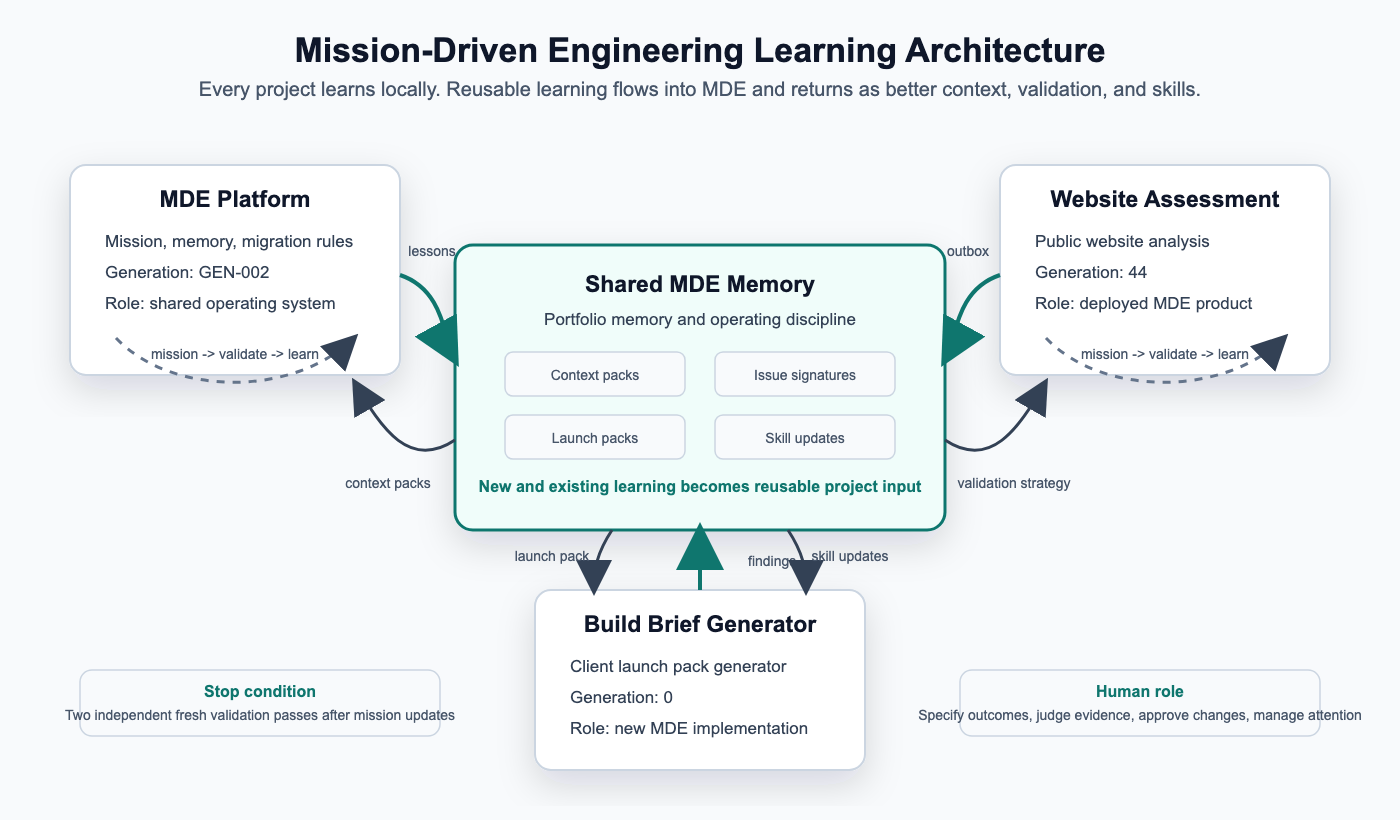
In Part 5, I explained why AI application generation reminded me of Model-Driven Engineering.
Traditional Model-Driven Engineering treated the model as the primary artifact. The model described the system, and tools generated implementation artifacts from that model.
In AI-assisted development, I think the primary artifact is shifting again.
It is not source code.
It is not even the application model.
It is the mission: the outcome, constraints, success criteria, and validation rules that define whether the application actually works.
That is the idea behind what I have been calling Mission-Driven Development.
The key mechanism is simple:
- Clearly specify the mission.
- Define project-specific validations.
- Run a learning loop that stops only when two independent, freshly generated validations pass the mission and the latest mission updates.
The important shift is that the system does not stop because an agent produced code.
It stops because independent validation repeatedly confirms that the generated application satisfies the mission.
A programming paradigm is emerging in AI systems: self-learning loops where agents generate, validators challenge, failures update the mission, and reusable lessons flow back into future work.
That pattern is showing up in many places.
This article is a walk-through of how I implemented it using three open-source repositories.
They play three different roles in the same MDE ecosystem:
- Northvalley-Intelligence/mde is the central MDE operating system. It stores shared memory, reusable context packs, launch packs, validation discipline, project routing, and lessons that should not stay trapped inside one application repo.
- Northvalley-Intelligence/local-website-growth-assessment is a real deployed product using MDE. It safely analyzes public local-business websites, evaluates lead-generation and demand-fit signals, and produces evidence-backed reports for business owners.
- Northvalley-Intelligence/client-website-build-brief-generator is a newer MDE implementation. It is designed to turn assessment reports, demand data, client intake, and validation logic into a website mission, technical brief, content checklist, validation plan, and Codex build prompt.
Implementation Snapshot
| Repository | MDE role | Current generation | Generation 0 validation focus |
|---|---|---|---|
mde | Shared memory and operating discipline | GEN-002 | Mission artifacts, required files, parse checks, and portfolio bootstrap evidence |
local-website-growth-assessment | Deployed product using MDE | 44 | Phase 0 foundation gate: repo structure, docs, CI, package boundaries, scoring weights, crawler policy, safe URL validation |
client-website-build-brief-generator | New MDE implementation | 0 | Required artifacts, JSON syntax, intake safety, privacy, field minimization, launch-package mapping |
What Mission-Driven Engineering Means
Mission-Driven Engineering, or MDE, is my attempt to turn AI-assisted development into a repeatable operating system.
The goal is not to make a coding agent write more code.
The goal is to make every project remember what it is trying to accomplish, prove that it is moving toward that outcome, and share useful learning with other projects.
In practice, MDE has a few core components.
The Mission
Each project starts with a mission.
The mission is not a vague product idea. It defines the outcome the system must create, the boundaries it must respect, and the risks it must avoid.
For example, the local website assessment project is not a generic SEO scanner. Its mission is to help local business owners understand why their website may not be generating more local customers, using safe public website analysis and plain-English recommendations.
That difference matters.
A generic SEO scanner can chase technical metrics.
The mission-driven version has to answer a business question.
Mission Updates
The first mission is never complete.
As validation finds gaps, the mission evolves.
A mission update might say:
- Do not show a confident report when public evidence is weak.
- PageSpeed failures must be reported honestly instead of invented.
- Broken-link claims must include concrete evidence.
- Demand fit must show found evidence, missing signals, confidence, and pages checked.
These updates prevent the project from repeatedly making the same mistake.
The mission becomes a memory of what the project has learned.
Generations
Instead of treating work as an endless stream of commits, MDE groups work into generations.
A generation has a goal, a mission version, validation evidence, findings, and a reason it ended.
This makes the process easier to inspect later.
When a project reaches Generation 44, that number is not just trivia. It means there is a recorded chain of mission changes, validation decisions, implementation changes, and learning.
The generation becomes a unit of accountability.
Project-Specific Validation
This is the part that changed how I think about AI-generated applications.
Generic validation is not enough.
Linting, type checking, unit tests, integration tests, build checks, and security scans are still useful. But they do not prove that the application satisfies its mission.
Project-specific validation asks a different question:
Does this system do the thing it exists to do?
For the website assessment product, that means validating safe public crawling, evidence-backed scoring, business-readable reports, honest unavailable measurements, and sufficient evidence before customer-facing recommendations appear.
For the client website brief generator, that means validating stale assessment detection, missing client information, confidentiality, launch-pack completeness, SEO/AEO requirements, and deployment constraints.
For the central MDE repo, that means validating mission artifacts, JSON/JSONL/YAML integrity, routing rules, launch packs, runbooks, and reusable context.
The validation must match the mission.
Independent Fresh Validation
The loop depends on fresh validation.
If the same agent that generated the implementation also judges the implementation, the process is too easy to fool.
The MDE pattern separates generation from validation. After implementation, a fresh validation pass challenges the result against the mission and the current validation strategy.
The phase exit rule is intentionally conservative:
Two independent validation gate passes are required before claiming readiness.
This does not make the system perfect.
It does make success harder to fake.
Findings And Failing BDDs
Validation failures are not just bugs.
They are learning signals.
MDE records unresolved findings, failing BDDs, deferred risks, false positives, repeated findings, and evidence quality.
That record matters because it changes the next generation.
If a validation finds that a report invented confidence, the next generation is not simply “fix the bug.” The next generation updates the mission and validation so the system is less likely to repeat that class of failure.
Outbox Learning
Every project learns locally.
Some lessons are reusable.
The local website assessment project might learn a better PDF validation rule, a better way to prevent unsupported claims, or a better pattern for branch/deployment governance.
That learning should not stay trapped inside one repository.
MDE uses outbox artifacts to identify lessons, impacts, content seeds, portfolio sync data, and possible skill updates that can be imported into the central MDE repo.
The central repo then turns reusable learning into context packs, launch packs, issue signatures, runbooks, or skill updates.
That reusable knowledge can flow back into new and existing projects.
The Architecture
The architecture is less about one tool and more about information flow.
Each project owns its code, mission, validation state, and local learning.
The central MDE repository owns reusable memory and operating discipline.
Reusable lessons move from projects into MDE. MDE sends improved context, validation strategy, launch packs, and skill updates back to projects.
This is the important point:
The projects are not merged into one monorepo.
They remain separate products.
MDE is the shared learning layer.
Repository 1: The MDE Platform
The main MDE repository is the shared memory system.
It is not the application being generated.
It is the operating discipline used to generate and validate applications.
Current state from the local MDE artifacts:
- Repository: Northvalley-Intelligence/mde
- Current generation:
GEN-002 - Current phase: one-time platform operating system setup
- Validation gate pass count:
2/2 - Role: shared portfolio memory, routing discipline, context packs, launch packs, and validation operating rules
The current generation summary shows that the platform setup passed validation with no blocking findings.
The project type is platform-memory, so its validation strategy is different from an application validation strategy. It does not need browser tests or performance checks. It needs artifact integrity, routing coverage, mission traceability, and reusable operating instructions.
Generation 0 for the MDE repo focused on creating the initial portfolio memory and migration discipline.
The Generation 0 validations were:
- Mission artifact checklist
- Required file and artifact review
- JSON parse checks
- Portfolio ledger and migration discipline review
- Evidence that the bootstrap artifacts existed and could be used by future projects
That sounds basic, but it was the right starting point.
Before MDE could guide projects, MDE itself needed durable memory.
Repository 2: Local Website Growth Assessment
The local website assessment project is the most mature MDE implementation in this set.
It is a deployed application, not just a planning repo.
Current state from the local project artifacts:
- Repository: Northvalley-Intelligence/local-website-growth-assessment
- Current generation:
44 - Current phase: Phase 1, complete vertical slice
- Readiness: ready for founder testing
- Staging:
https://staging-assessment.northvalleyintel.com - Production:
https://assessment.northvalleyintel.com
The mission is focused on helping local business owners understand why their website may not be generating more local customers.
That mission produced very specific validations.
The product has to safely crawl public pages. It must respect robots.txt, stay on the submitted domain, avoid private networks, avoid submitting forms, limit crawl depth, and avoid overloading the assessed site.
It must also produce a useful business report.
That means every recommendation needs evidence, business impact, and a plain-English action. The report must distinguish measured evidence from unavailable evidence. If PageSpeed fails, the report must say that honestly. If evidence is insufficient, the application must not produce a confident customer-facing report.
The current generation, Generation 44, synced updated demand intelligence from a separate demand-data-generation project. The app now carries 540 active demand records and 214 records with monthly search counts, including expanded Real Estate demand coverage.
Its Generation 44 validation included:
- Format, lint, typecheck, unit tests, integration tests, build, and Cloudflare build
- Focused demand satisfaction tests
- Built-package smoke checks
- Staging deployment validation
- Production deployment validation
- Live self-QA on a Real Estate website report
This repository is also useful because it shows the historical evolution of MDE.
It predates the current GEN-000.json convention. Its Generation 0 equivalent was the Phase 0 foundation session on June 5, 2026.
The initial validation was foundation-oriented:
- Required repository structure and docs exist
- Root documentation makes the mission and current phase visible
- Environment strategy is documented without committed secrets
- CI runs install, lint, typecheck, unit tests, integration tests, and build
- Fresh BDD scenarios exist with Critical and High classifications
- Package boundaries compile
- Scoring weights, crawler policy, safe URL validation, and report disclaimer are present
From there, the validation strategy became much richer.
Later generations added checks for evidence sufficiency, thin evidence, report hierarchy, negative-finding evidence, business explainability, external measurement truthfulness, competitive validation, and demand satisfaction.
That evolution is the point.
The project learned what quality meant for its mission.
Repository 3: Client Website Build Brief Generator
The client website build brief generator is a newer MDE project.
It exists to turn assessment reports, demand data, client intake, and MDE validation logic into a website launch pack.
Current state from the local project artifacts:
- Repository: Northvalley-Intelligence/client-website-build-brief-generator
- Current generation:
0 - Current phase: Generation 0
- Implementation status: not started
- Role: generate client website mission, technical brief, content needs, validation plan, and Codex build prompt
This repository is valuable because it shows what a clean Generation 0 looks like after the MDE discipline matured.
The project does not start by building the generator.
It starts by defining the mission, dependencies, risks, task graph, validation strategy, and intake-portal specification.
The mission is clear: generate the latest client website build prompt, client intake checklist, technical brief, website mission, content needs, and validation plan using assessment reports, client intake, demand data, and current MDE validation logic.
The validation strategy is already project-specific.
Generation 0 identifies several critical validation areas:
- The generated launch pack must include a repo-ready Codex build prompt, website mission, client intake summary, content-needed checklist, technical brief, validation plan, and deployment checklist.
- Every major recommendation must trace to assessment evidence, client intake, or a documented assumption.
- Missing or stale assessment data must be called out instead of treated as fact.
- Missing client details must be listed instead of invented.
- SEO/AEO requirements must include services, service areas, FAQs, schema guidance, sitemap expectations, and crawlability.
- The technical brief must enforce the current Northvalley baseline: GitHub organization,
mainbranch, Next.js, TypeScript, React, npm, Node 22, OpenNext for Cloudflare, Wrangler, linting, type checking, tests, Playwright, and audit checks. - Deployment guidance must prevent accidental production drift between branches and deployed sites.
- Client-safe artifacts must exclude private central ledgers, cross-client lessons, and confidential internal strategy.
Its Generation 0 validations included:
- Required artifact review
- JSON syntax checks
- Intake portal field-minimization review
- Assessment default safety review
- Intake portal privacy review
- Launch-package mapping review
The full validation gate has not run yet because there is no implementation or generated sample launch pack to validate.
That is the correct result.
MDE does not pretend a system is validated before the thing exists.
It records what can be validated now and what must wait.
What These Projects Have In Common
The three repositories are at different maturity levels.
The MDE platform is shared memory.
The local website assessment project is a deployed application that has gone through many generations.
The client website build brief generator is a new Generation 0 project preparing to implement.
Despite that, the structure is consistent.
Each project has:
- A mission
- Mission updates or equivalent operating notes
- A current generation or phase state
- Validation artifacts
- Findings or failing BDD state
- Risk tracking
- A way to record reusable learning
- A path for human review and phase readiness
That consistency is what makes the system feel different from ordinary prompt-based coding.
The prompt is not the process.
The mission, validation, and learning loop are the process.
Why The Learning Loop Matters
AI coding agents are very good at producing plausible implementation.
That is useful, but it is not enough.
The hard question is whether the application should exist in that shape.
Did it solve the real problem?
Did it preserve the important constraints?
Did it expose risks honestly?
Did it learn from previous failures?
Did that learning improve other projects?
The self-learning loop gives the system a way to improve beyond one code generation.
When the website assessment project learned that unsupported claims need concrete evidence, that lesson could influence future validation strategies.
When the brief generator needs to create website build prompts, it can inherit that lesson and require evidence traceability from the start.
When MDE sees the same issue signature across projects, it can become a reusable context pack or skill update.
That is how local learning becomes organizational learning.
AEO and SEO Implications
There is also an interesting content and discoverability angle here.
Search engines and answer engines increasingly reward clear, structured, evidence-backed explanations.
Mission-Driven Engineering pushes software projects in the same direction.
The project must state what it does.
It must explain why decisions were made.
It must preserve evidence.
It must separate measured facts from assumptions.
It must make outputs easier for humans and machines to inspect.
That is good engineering.
It is also good answer-engine optimization.
Frequently Asked Questions
What is Mission-Driven Engineering?
Mission-Driven Engineering is a software development discipline where the mission, validation strategy, findings, generations, and reusable learning become first-class artifacts. The goal is to generate applications that can prove they satisfy the mission, not merely generate code.
How is Mission-Driven Engineering different from Model-Driven Engineering?
Model-Driven Engineering treats the model as the primary artifact. Mission-Driven Engineering treats the mission as the primary artifact. AI agents can fill in more implementation detail than traditional generators, so the mission focuses on outcomes, constraints, validation, and learning.
Why require two independent validation passes?
One validation pass can be lucky or too closely tied to the implementation. Two independent fresh validation passes make readiness harder to fake and force the system to prove that the latest mission and mission updates are satisfied repeatedly.
What is Generation 0 in MDE?
Generation 0 establishes the mission, project identity, dependencies, risks, validation strategy, and initial artifacts before implementation. A mature Generation 0 should make it clear what will be built, how it will be validated, and what must not be invented or exposed.
Looking Ahead
When I started this series, I thought the main story was that AI would move us from code generation to application generation.
That is still true.
But the implementation taught me something more specific.
Application generation is not just about generating more artifacts.
It is about creating a system that can remember the mission, validate the outcome, learn from failure, and transfer reusable lessons across projects.
The code is still important.
But in this style of development, code is no longer the center of gravity.
The center of gravity is the learning loop.