
The End of Software Scarcity, Part 1: Why Software Can Adapt to the Business
Published:
The End of Software Scarcity, Part 1: Why Software Can Adapt to the Business
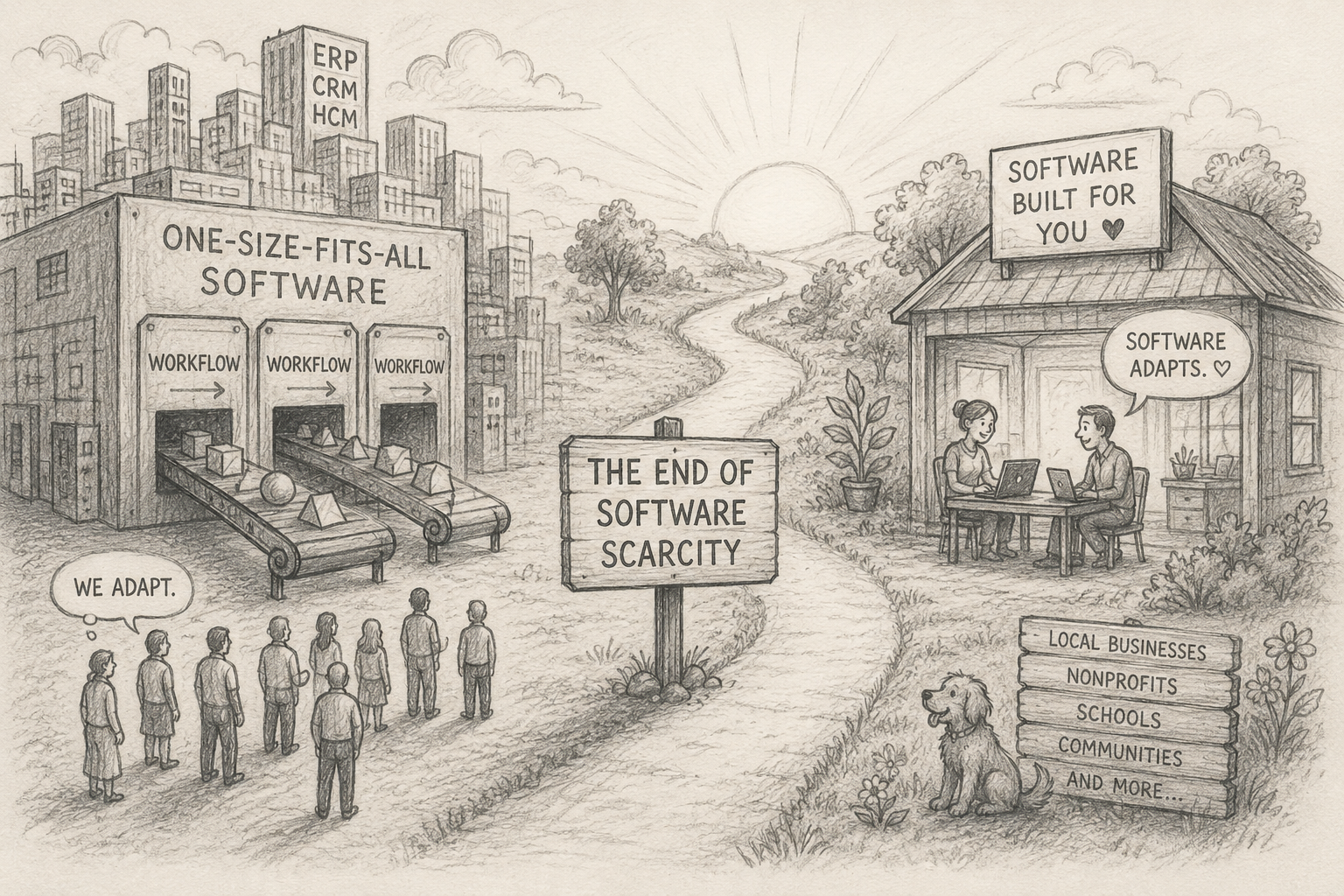
One of the least discussed consequences of AI may be the end of software scarcity.
For most of the software era, organizations adapted themselves to software because software was expensive to build, expensive to customize, and expensive to maintain. Fortune 500 companies spent years reshaping their operations around ERP platforms. Small businesses did the same with industry-specific products, accepting generic workflows because bespoke solutions were out of reach.
The economics were simple: changing the business was cheaper than changing the software.
AI-assisted development is beginning to challenge that assumption. When a small team—or even a single experienced developer—can rapidly build, customize, and maintain software, the balance shifts. For the first time, software can economically adapt to the business instead of the business adapting to the software.
This shift has the potential to create an entirely new generation of small software companies serving niche industries, local organizations, and communities whose needs have long been overlooked by the traditional software market.
Why Was Software Expensive?
Software was expensive because building and maintaining it required specialized teams and significant coordination. A typical product involved product managers, designers, developers, testers, and operations staff, all working through a process filled with uncertainty and change.
Because of these costs, software vendors had to serve large markets to make the economics work. Organizations with unique needs rarely received tailored solutions. Instead, they adapted their processes to fit the software available to them.
The result was a world where software was abundant for common problems but scarce for specialized ones.
What Changed?
The most obvious answer is artificial intelligence, but the deeper answer is leverage.
For decades, software development was constrained by the amount of human effort required to design, write, test, document, and maintain code. Every new feature required significant time and coordination across specialized teams.
AI-assisted development changes that equation. Modern coding agents can generate code, create tests, explain unfamiliar systems, draft documentation, and accelerate debugging. Tasks that once took days may now take hours, and tasks that took weeks may now take days.
This does not eliminate the need for experienced engineers. Rather, it increases their leverage. A small team can now accomplish work that previously required a much larger organization.
The result is a dramatic reduction in the cost of creating and maintaining software. As that cost falls, markets that were once too small to justify custom solutions become economically viable. For the first time, businesses and organizations with highly specialized needs can realistically consider software built specifically for them rather than settling for software built for everyone.
The Shrinking Minimum Viable Market
Historically, software products needed large markets to justify their development costs. Vendors built solutions that could be sold to thousands of customers because the cost of creating and maintaining software demanded scale.
As development costs fall, so does the minimum market size required to support a software business.
A product no longer needs thousands of customers to be viable. It may need hundreds. In some cases, dozens may be enough. Increasingly, even a single organization can justify software tailored to its specific needs.
This shift changes more than software economics. It changes who can participate in the software economy. Markets that were previously ignored because they were too small can now become viable opportunities for entrepreneurs, consultants, nonprofits, and local communities.
The Rise of the Micro Software Company
For most of the software era, successful software companies needed scale. Development costs, support requirements, infrastructure, and ongoing maintenance meant that a product typically needed thousands of customers to become a sustainable business.
As the cost of building and maintaining software falls, a new type of company becomes possible: the micro software company.
These businesses may consist of a single founder or a small team of fewer than ten people. Rather than pursuing massive markets, they can focus on specific industries, local communities, or narrowly defined problems that were previously too small to serve economically.
A micro software company does not need to become the next Salesforce or ServiceTitan. It may serve local cleaning companies, animal shelters, churches, school districts, specialty manufacturers, or regional service providers. What makes these opportunities viable is not the size of the market, but the dramatically lower cost of creating and maintaining software.
In many ways, software is following a path similar to publishing, video production, and e-commerce. Technologies that reduced the cost of creation enabled millions of new participants to enter those markets. AI-assisted development may have a similar effect on software, allowing entrepreneurs and small teams to build solutions for communities and industries that have historically been overlooked.
The most significant beneficiaries of this shift may not be technology companies themselves. They may be the millions of organizations that can finally afford software designed around their specific needs rather than software designed for the average customer.
While the economics suggest that a new generation of micro software companies may emerge, the more important question is whether these changes create meaningful value for the organizations they serve. It is one thing to argue that software can now be built more quickly and at lower cost. It is another to demonstrate that small businesses and community organizations can actually benefit from software tailored to their specific needs.
To explore that question, we need a real-world example.
Coming Next: A Case Study
The theory is compelling: lower development costs should make it possible to build software for markets that were previously too small to serve. But economic theories are easy to propose and much harder to validate.
If software scarcity is truly coming to an end, evidence of that change should already be visible—not in Silicon Valley boardrooms or venture capital portfolios, but among the small businesses and community organizations that have historically been overlooked by the software industry.
In the next article, I will examine a small local business and explore what becomes possible when modern AI tools dramatically reduce the cost of creating software. The goal is not to showcase technology for its own sake, but to understand whether AI can unlock meaningful value for organizations that have traditionally been priced out of custom software.
If the end of software scarcity is real, we should be able to observe it at the smallest scales first.