
CPU vs GPU battle, Round 1: adapt the generalist, read the logits
Published:
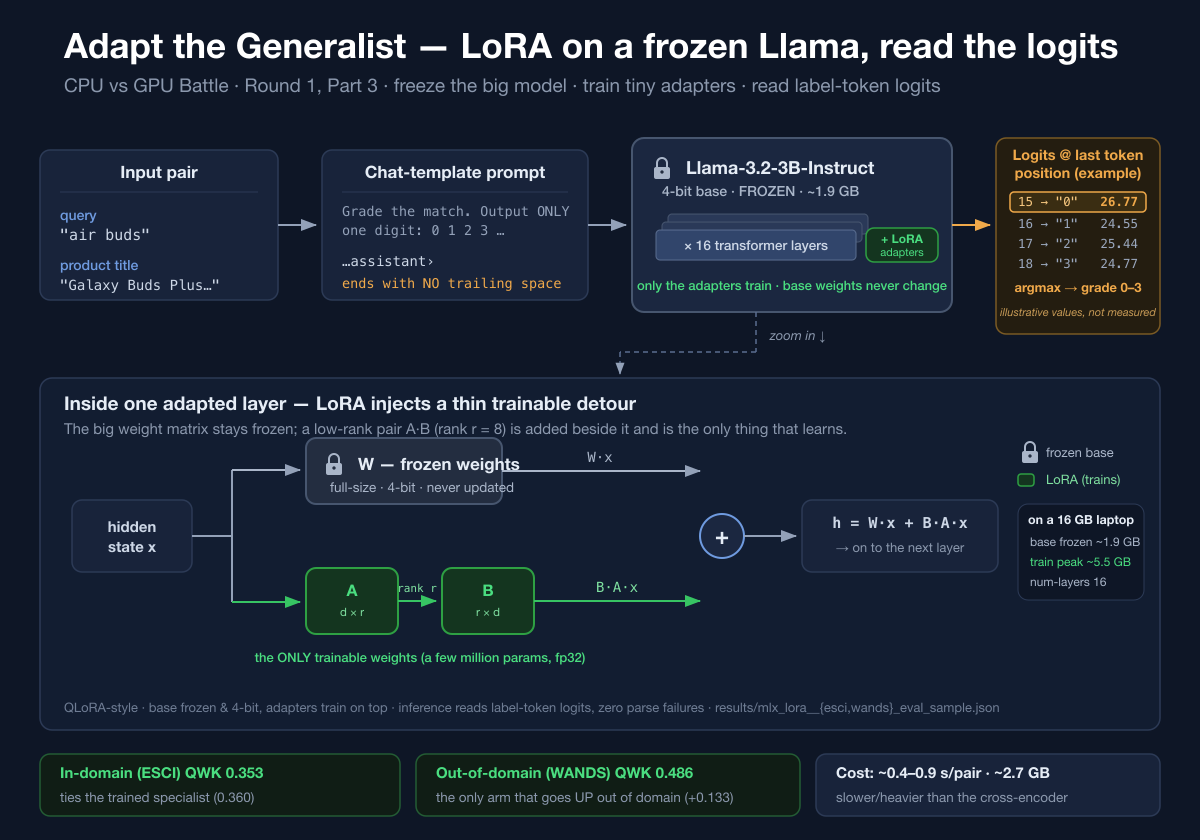
Part 3 of the series. Part 1 prompted a generalist and watched it miscalibrate. Part 2 trained a specialist and watched it win in-domain but travel less well. This round we try the third thing: keep the generalist, but stop prompting it - LoRA-tune it on the laptop GPU and read the grade straight off the logits.
The Short Version
Part 2’s cross-encoder was the first arm to beat the shipped on-device judge, but it was a specialist - trained on Amazon ESCI product search, and you could see it leaning on that domain when it met furniture (WANDS). This round asks the opposite question: instead of building a purpose-made classifier, can we take the generative model from Part 1 - Llama-3.2-3B - and adapt it into a grader with a small LoRA, still entirely on the laptop’s GPU?
Two changes make that work on a 16 GB machine:
- LoRA on a 4-bit base. We freeze a 4-bit quantized Llama-3.2-3B (~1.9 GB on disk) and train only small low-rank adapters on top - QLoRA-style, via Apple’s
mlx_lm. Training peaked at about 5.5 GB of RAM, comfortable on a 16 GB laptop. - Read the logits, don’t generate text. At inference we don’t ask the model to write JSON. The digits
0 1 2 3are single tokens; we read the model’s logits for those four tokens at the one position where the grade goes and take the argmax. No free generation, no parsing, zero parse failures.
The result is the interesting one of the series so far. In-domain, the adapted generalist lands about even with the trained specialist (ESCI QWK 0.353 vs the cross-encoder’s 0.360). But out of domain it is the only arm that does not fall: on WANDS it scores QWK 0.486, while BM25, the prompted model, and the cross-encoder all drop from their ESCI numbers. That is a lead worth chasing, not a victory lap - and below I am careful about why.
(Numbers: results/mlx_lora__{esci,wands}_eval_sample.json; journal 07-arm-d-lora.md. n = 3,000 pairs per set, held-out, independent human labels.)
Where we left off: a specialist that showed its seams
Part 2’s bge-reranker-v2-m3 cross-encoder won the deployment tradeoff outright - more accurate than the prompted judge and ~200x faster - but it ended on a crack. Its edge on WANDS furniture (QWK 0.299) was real but thinner than on its home turf, ESCI (0.360). That is the classic shape of a model that fit its training domain well and travels less well. A cross-encoder with a bolted-on 4-class head has no choice: it only knows what it was trained on.
So the Part 3 move is to keep the broad prior knowledge a general chat model already has - it has “seen” furniture, electronics, and negation queries in pre-training - and just teach it this scale with a light touch, rather than building a classifier from the domain up.
The idea: adapt a generalist instead of training a specialist
New to LoRA? LoRA (Low-Rank Adaptation) is a way to teach a model a new skill without retraining all of its billions of weights. You freeze the original model untouched and slip small pairs of low-rank matrices - the adapters - into its layers; only those tiny matrices ever get trained. Here it’s the QLoRA flavor: the base Llama is 4-bit quantized and frozen (~1.9 GB), and the adapters train on top (peaking ~5.5 GB on a 16 GB Apple-Silicon laptop, 16 layers adapted). The payoff is that the trainable part is tiny and quick to train, and because the base model stays intact you can keep it and swap a different adapter in for a different task.
There are three genuinely different ways to turn a (query, product title) pair into a grade, and this series has now built all three. Side by side:
| Approach | How it judges | Training | This-round result |
|---|---|---|---|
1 · Prompted generalist — llama3.2:3b (Part 1) | Zero-shot: generates JSON, you parse the digit back out | None — off the shelf | ESCI QWK 0.288 · WANDS 0.244 |
2 · Trained specialist — bge cross-encoder (Part 2) | Argmax over a bolted-on 4-class head — discriminative, no text | Whole model fine-tuned on ESCI, Apple-Metal (MPS) GPU | ESCI QWK 0.360 · WANDS 0.299 |
3 · Adapted generalist — Llama-3.2-3B + LoRA (this round) | Reads the four label-token logits, argmax — no generation | LoRA adapters only, frozen 4-bit base, on the GPU | ESCI QWK 0.353 · WANDS 0.486 |
The same contrast in words:
- Approach 1 - prompt a generalist (Part 1). Take
llama3.2:3boff the shelf, hand it a two-line rubric, and ask it to generate a grade as JSON. No training. It improvises the rubric on every call, and you have to parse free text back out. - Approach 2 - train a specialist (Part 2). Take a cross-encoder, replace its head with four class logits, and fine-tune the whole thing on ESCI. It is discriminative - it does not generate anything, it scores. One forward pass, an argmax, no text.
- Approach 3 - adapt a generalist (this round). Take the generative
Llama-3.2-3B, add LoRA adapters, and train only those on ESCI so the frozen base keeps its general knowledge. Then, at inference, skip generation entirely and read the label-token logits. A generative model turned into a judge by adaptation, not by prompting and not by rebuilding.
The point of Approach 3 is to get the reliability of a classifier (no parsing, no malformed output) without throwing away the broad prior that a general model carries into domains the training set never covered.
How you read a grade off the logits
This is the mechanic that makes the arm honest, so it is worth being concrete. In this tokenizer, "0", "1", "2", "3" each encode to a single token (ids 15, 16, 17, 18 - a leading space would split them into two tokens, so the prompt is built to avoid one). The chat template ends the prompt right where the assistant’s answer begins, with no trailing space, so the very next token position is unambiguously the grade digit.
That means we never let the model talk. We run one forward pass over the prompt, look at the logits for exactly those four token ids at that final position, and take the argmax. For a given pair the model emits four label-token logits and we take the largest - they might look like [26.77, 24.55, 25.44, 24.77] (illustrative, not measured values), where the argmax lands on grade 0.
Two consequences fall out for free:
- No parse failures, ever. The results file records
parse_failure_count: 0with the note “not applicable - argmax over the 4 label-digit token logits at one forward-pass position, no free-generation or text parsing.” Part 1’s prompted arm had to strip<think>tags and fences and occasionally threw a pair away; a logit read cannot malform its output, exactly like Part 2’s classifier. - It is a fair comparison of method, not data. Arm D trains on the identical 36k-row balanced ESCI split the Part 2 cross-encoder used (a 4k dev split held aside), so Approach 2 vs Approach 3 is a clean comparison of cross-encoder classifier against generative LoRA logit-read, not of who got the better training rows.
Training it on the laptop GPU
The GPU does real work again this round. On the Apple-Metal GPU via mlx_lm, we LoRA-tune the 4-bit base for one full epoch (9,000 iterations over the 36k rows, batch size 4, --num-layers 16, learning rate 1e-5), computing the loss only on the completion digit (--mask-prompt), not on the instruction text. On a 16 GB machine the run peaked at about 5.5 GB of RAM and took a handful of hours - the kind of job you start before dinner and read the next morning, no datacenter, no API.
The 4-bit base is a deliberate choice, not a shortcut: an fp16 3B model is ~6-7 GB in weights alone, which leaves almost no headroom for activations and optimizer state on a 16 GB laptop. Freezing a 4-bit base and training fp32 LoRA adapters on top is mlx_lm’s well-supported path and the reason this fits at all.
As always in this series, every score below is measured against independent human-derived labels (Amazon ESCI and WANDS), never the service’s own past judgments - roughly 92% of those were written by the same local model, so agreeing with them would measure reproduction, not accuracy. That circularity trap from Part 1 still governs every number here.
Does it win? In-domain it ties; out of domain it holds
Here is the whole board, all four arms this series has built, on the same seeded held-out samples. Compare arms down a column (within one dataset) - the ESCI and WANDS columns are not on the same ruler, and I say why right after the table.
| Arm | ESCI QWK | WANDS QWK | ESCI → WANDS | speed / pair | memory |
|---|---|---|---|---|---|
| A · BM25 lexical | 0.222 | 0.155 | –0.067 | instant | tiny |
B · Prompted llama3.2:3b (≈ shipped judge) | 0.288 | 0.244 | –0.044 | ~1–5 s | ~5–6 GB |
| C · bge cross-encoder, fine-tuned (Part 2) | 0.360 | 0.299 | –0.061 | ~28 ms | ~1 GB |
| D · Llama-3.2-3B + LoRA, logit-read (this round) | 0.353 | 0.486 | +0.133 | ~0.4–0.9 s | ~2.7 GB |
(Arm D: ESCI QWK 0.353, 95% CI 0.320-0.385, accuracy 0.483, off-by-one 0.722, mean nDCG 0.840; WANDS QWK 0.486, 95% CI 0.453-0.517, accuracy 0.603, off-by-one 0.816, mean nDCG 0.884 - all from results/mlx_lora__{esci,wands}_eval_sample.json, inference peak RSS ~2.67 GB, warm median ~0.87 s/pair on ESCI. Arms A-C from Parts 1-2 and results/bge_reranker__*.json.)
Read the last two columns together, because that is where the story lives:
- In-domain, the adapted generalist ties the specialist. On ESCI, Arm D’s 0.353 and Arm C’s 0.360 sit inside each other’s confidence intervals (D: 0.320-0.385). Building the grader by adapting a generalist got essentially the same in-domain accuracy as training a purpose-built classifier. That alone is a result: you did not have to give up the general model to get classifier-grade reliability.
- Out of domain, it is the only arm that goes up. Every other arm loses ground from ESCI to WANDS - BM25 -0.067, the prompted model -0.044, the specialist cross-encoder -0.061. Arm D moves the other way: +0.133. It is the single arm in the whole experiment whose ordinal agreement improves on a domain it never trained on.
Why “0.486 > 0.353” is a lead, not a trophy
I want to be exact about what that +0.133 does and does not prove, because it is the easiest number in this series to over-claim.
- You cannot compare the two datasets directly. WANDS uses a coarser 3-class label space (Exact / Partial / Irrelevant, no grade-1 bin), which is simply an easier target than ESCI’s four grades. So “0.486 on WANDS beats 0.353 on ESCI” is not a valid sentence - they are different rulers. The claim is not that Arm D is better on WANDS than on ESCI in absolute terms.
- What is comparable is the direction, across arms. Every arm was scored on the same two rulers. Three of the four degrade going out of domain; one does not. That cross-arm pattern - who holds up and who slides - is a fair comparison even when the absolute cross-dataset numbers are not. Arm D holding up (indeed improving) is the honest signal.
- One out-of-domain collection is not proof of generalization. WANDS is a single domain (furniture). A model that travels well to one new domain has earned a hypothesis, not a law. The real test is a reverse run - train on WANDS, test on ESCI - and see whether the adapted generalist still holds up when the home and away fields are swapped. That is deliberately left as future work; I would rather flag it than quietly bank the win.
So the fair summary is: adapting a generalist looks like it may travel better than training a specialist - a lead strong enough to chase, on the strength of being the only arm that did not degrade out of domain, and honest enough to admit it rests on one collection and a coarser label space.
Where it loses (because it does)
- It did not beat the specialist in-domain. On ESCI, Arm C is still nominally ahead (0.360 vs 0.353), even if the gap is inside the noise. If ESCI product search were the only domain you cared about, Part 2’s cross-encoder is still the arm to ship - and it is far cheaper to run.
- It is slower and heavier than the specialist. A generative 3B forward pass - even reading a single position - runs at roughly 0.4-0.9 s/pair and ~2.7 GB of RAM at inference, versus the cross-encoder’s ~28 ms and ~1 GB. That is much faster than Part 1’s prompted arm (seconds, and it actually generated text), but it is still one to two orders of magnitude off the specialist. Adaptation buys generalization; it does not buy the classifier’s speed.
- The absolute ceiling is still modest. QWK in the low-to-mid 0.3s (ESCI) is better, not good. Every arm in this experiment lives in the ~0.3-0.5 neighborhood; a lead over the baseline is not a solved problem, and I am not going to dress it up as one.
Honest caveats (they travel with every round)
- Compare arms within a dataset, never across. Restating it because it is the one that makes the headline honest: the ESCI and WANDS columns use different label spaces and are not on the same scale. Read down a column.
- This is an on-device contest, not “we beat the cloud.” The shipped service default is cloud-first (a hosted Gemini model), which was not benchmarked here and would very likely beat every laptop-bound arm. The win we chase is narrow and specific: the best relevance grader that runs on this machine with no API call - for privacy, cost, and offline reasons.
- The GPU is the Apple M-series integrated GPU (Metal), not a discrete card. No hand-written CUDA or Metal kernels -
mlx_lmhandles device dispatch. The whole thing, training and inference, fits on a 16 GB laptop, which is the entire point. - Agreement with the service’s own history is reproduction, not accuracy - the circularity trap from Part 1 still holds, which is why every number here is against independent labels.
Next: leave the laptop
Three rounds in, the on-device picture is clear enough to name a winner per goal: if you only serve ESCI-shaped product search, the Part 2 cross-encoder is the arm - fastest, lightest, best in-domain. But if you care about grading queries from domains you did not train on, the adapted generalist is the one that did not fall over, and that is the more interesting lead.
The open question the whole series has been circling is still open: is the ~0.3-0.5 QWK ceiling the task - pointwise relevance grading is just hard - or is it the size of a model that fits on a laptop? Every arm so far has been laptop-bound by design. In Part 4 we finally leave the machine and hand the same problem, the same held-out labels, to a real datacenter GPU - to find out whether the ceiling moves when the hardware does. And somewhere in there is the reverse generalization test this round earned but did not run.
Same rules every round: independent labels, held-out numbers, and the losses reported next to the wins.
Code and reproduction details: github.com/Northvalley-Intelligence/cortex/tree/main/experiments/relevancy-replacement — journals 00-08 and results/*.json.