
CPU vs GPU battle, Round 1: train the judge, don’t prompt it
Published:
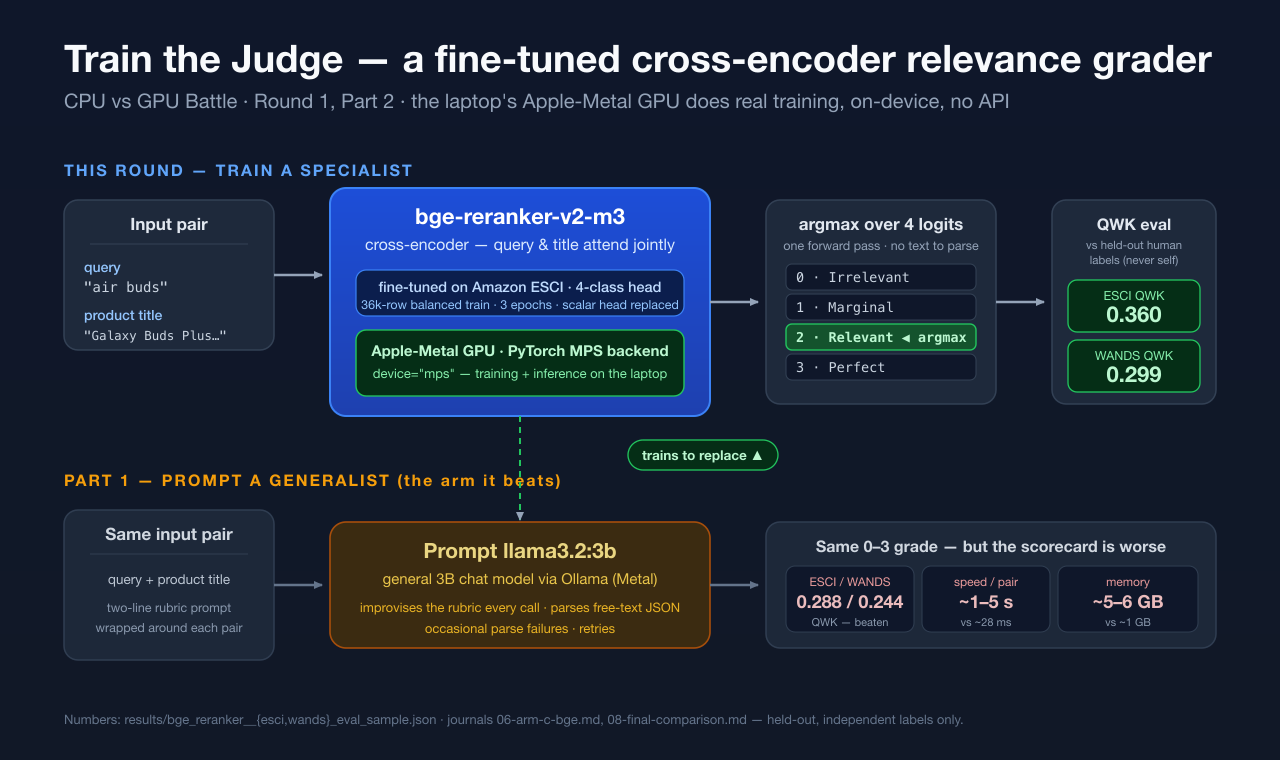
Part 2 of the series. In Part 1 we prompted a general-purpose model to grade search relevance and watched exactly where it fell over. This time we stop asking a generalist to guess and train a specialist instead - on the laptop’s own GPU. It becomes the first arm to actually beat the shipped on-device judge.
The Short Version
Part 1 left us with a prompted llama3.2:3b that grades e-commerce search relevance on the 0-3 scale, is fast enough, and is honest-to-goodness okay - but misses mostly by miscalibration, not by misunderstanding. The fix this round is not a bigger prompt. It’s a different tool: a cross-encoder, bge-reranker-v2-m3, fine-tuned on Amazon’s ESCI data with a small 4-class head bolted on. Training runs on the MacBook’s Apple-Metal GPU (PyTorch’s MPS backend) - the GPU finally does real work, on the same machine, no datacenter, no API.
The result: it’s the first arm to beat the shipped on-device judge on both independent test sets - ESCI QWK 0.360 vs the prompted model’s 0.288, WANDS 0.299 vs 0.244 - while running at ~28 ms/pair instead of seconds, in ~1 GB of RAM instead of 5-6. That’s roughly two orders of magnitude faster and ~5x lighter, for better accuracy.
And - because this series reports the losses too - it’s a specialist. It was trained on ESCI product search, and you can see it leaning on that: its edge shrinks on WANDS (furniture), a domain it never saw. Holding that thought is the whole setup for Part 3.
(Numbers: results/bge_reranker__{esci,wands}_eval_sample.json; journals 06-arm-c-bge.md, 08-final-comparison.md.)
Where we left off: a calibration problem, not a comprehension problem
The Part 1 diagnosis was specific. The prompted model mostly understood the query - it rarely called a perfect match irrelevant - it just put the boundary in the wrong place, sliding a “2 - Relevant” to a “1 - Marginal” and back. A calibration problem. When the failure is calibration, you don’t need a smarter conversationalist. You need something that has seen the labels and learned where the lines actually are.
That’s the pivot for this round: stop prompting a general model and start training one. Prompting asks a model that was built to chat to improvise a grading rubric on every call. Fine-tuning bakes the rubric in.
The idea: a cross-encoder, not a chatbot
A cross-encoder is the unglamorous, right tool for pointwise relevance. Instead of generating text, it takes the (query, product title) pair together, lets every query token attend to every title token, and emits a score. We take BAAI/bge-reranker-v2-m3 - a reranker already good at “does this passage answer this query” - and replace its scalar head with a 4-way classification head, one logit per grade: 0 Irrelevant, 1 Marginal, 2 Relevant, 3 Perfect. Inference is a single forward pass and an argmax over four numbers.
One quiet but real consequence: there is no text to parse, so there are zero parse failures - the field in the results file literally reads “not applicable - argmax over a 4-way classification head, no free-text parsing” (results/bge_reranker__esci_eval_sample.json). Part 1’s prompted arm had to strip <think> tags and fences and occasionally threw a pair away when the JSON came back malformed. A classifier can’t malform its output. That reliability is part of why it’s ~200x faster: no generation, no retries, no salvage.
Training it - this is where the GPU actually shows up
Part 1’s “GPU” was mostly Ollama quietly using Metal to run a 3B model. Here the GPU does the thing GPUs are for: training. On the laptop’s Apple-Metal GPU (CrossEncoder(model_dir, device="mps") - scripts/train_bge.py), we fine-tune on a balanced 36k-row ESCI train split with a 4k dev split, for 3 epochs. Best dev QWK peaked at 0.471 (06-arm-c-bge.md).
Everything is measured against independent human-derived labels - Amazon ESCI and WANDS - never against the service’s own past judgments, because ~92% of those were produced by the same local model, so “agreeing” with them would measure reproduction, not accuracy. (That’s the circularity trap from Part 1, and it still governs every number here.)
Does it actually win?
Yes - and this is the first time in the series I get to write that without a caveat swallowing the sentence. Held-out, on the same seeded test samples every other arm was scored on:
| Arm | ESCI QWK | WANDS QWK | speed / pair | memory |
|---|---|---|---|---|
Prompted llama3.2:3b (Part 1, ≈ shipped on-device judge) | 0.288 | 0.244 | ~1-5 s | ~5-6 GB |
| bge cross-encoder, fine-tuned (this round) | 0.360 | 0.299 | ~28 ms | ~1 GB |
(ESCI QWK 0.360, 95% CI 0.325-0.391; WANDS 0.299, CI 0.262-0.334; warm median 27.9 ms/pair, p95 40 ms; peak RSS ~1.06 GB - all from results/bge_reranker__esci_eval_sample.json / …wands_eval_sample.json.)
Read it carefully, because the two axes both move the right way:
- Accuracy up on both sets. It beats the prompted judge on ESCI and on WANDS - and it never trained on WANDS. So it isn’t just memorizing ESCI; the calibration it learned carries to a domain it hasn’t seen. That’s the direct fix for Part 1’s failure mode.
- Speed and memory down by orders of magnitude. ~28 ms vs seconds is 1-2 orders of magnitude; ~1 GB vs 5-6 GB is ~5x lighter. For a service that grades thousands of pairs, that’s the difference between a batch job and a coffee break.
If you only wanted the deployment answer - more accurate AND faster than the on-device judge, on this machine - this arm is it.
Where it loses (because it does)
- The absolute ceiling is still modest. QWK 0.360 is better, not good. Pointwise relevance grading is genuinely hard - landing near ~0.3-0.5 is the neighborhood every arm in this experiment lives in. A win over the baseline is not a solved problem, and I’m not going to dress it up as one.
- There’s a real train/test gap. Dev QWK peaked at 0.471; held-out ESCI came in at 0.360 (
06-arm-c-bge.md). The honest number is the held-out one. The 0.471 is what it looked like from the inside during training, and the gap is exactly the kind of thing that’s tempting to quote and wrong to. - On the service’s own past grades it “disagrees” - and that’s correct. On the Cortex-validation set bge scores only 0.305. But that set is ~92% grades from the prompted model, so a genuinely independent judge should diverge there. Low agreement is the arm behaving honestly, not failing.
- It’s a specialist, and the seams show. Its edge on WANDS (0.299) is real but thinner than on its home turf, ESCI (0.360) - the classic shape of a model that fit its training domain well and travels less well. That crack is the entire premise of Part 3: a differently-trained arm that gives up some in- domain polish to generalize better. Watch this space.
Honest caveats (they travel with every round)
- Compare arms within a dataset, never across. WANDS uses a coarser 3-class label space (no grade 1), so a WANDS number and an ESCI number aren’t on the same ruler.
- This is an on-device contest. The shipped service default is cloud-first (a hosted Gemini model), which was not benchmarked here and would likely beat every laptop-bound arm. The claim is “no API, runs on this machine, and it beat the local judge” - not “beats the frontier cloud models.”
- Agreement with the service’s own history is reproduction, not accuracy - see the 0.305 above.
- The GPU here is the Apple M-series integrated GPU (Metal), not a discrete card. No hand-written CUDA or Metal kernels - PyTorch’s MPS backend handles device dispatch. The whole thing fits on a laptop, which is the point.
Next: read the logits
The cross-encoder wins the deployment tradeoff, but it’s a purpose-built classifier - and we just saw it lean on its training domain. What if we keep a generative model - the same Llama-3.2 family from Part 1 - but instead of prompting it, we fine-tune a LoRA adapter and read the label-token logits directly, no free generation at all? Does a generalist-that-was-taught generalize better out of domain than a specialist-that-was-trained? That’s Part 3 - still on the laptop’s GPU. Then, in Part 4, we finally leave the machine and hand the problem to a real datacenter card to ask a different question entirely: is the ~0.3-0.5 ceiling the task, or just the size of a laptop model?
Same rules every round: independent labels, held-out numbers, and the losses reported next to the wins.
Code and reproduction details: github.com/Northvalley-Intelligence/cortex/tree/main/experiments/relevancy-replacement — journals 00-08 and results/*.json.