
AI Doesn’t Have a Coding Problem. Enterprises Have a Permission Problem.
Published:
Everyone is talking about AI productivity.
Developers write code faster.
Product managers write requirements faster.
Analysts create reports faster.
Yet I have a suspicion that many large enterprises will spend millions on AI initiatives and see only marginal improvements in how quickly they deliver value.
Why?
Because AI doesn’t have a coding problem.
Enterprises have a permission problem.
A Thought Experiment
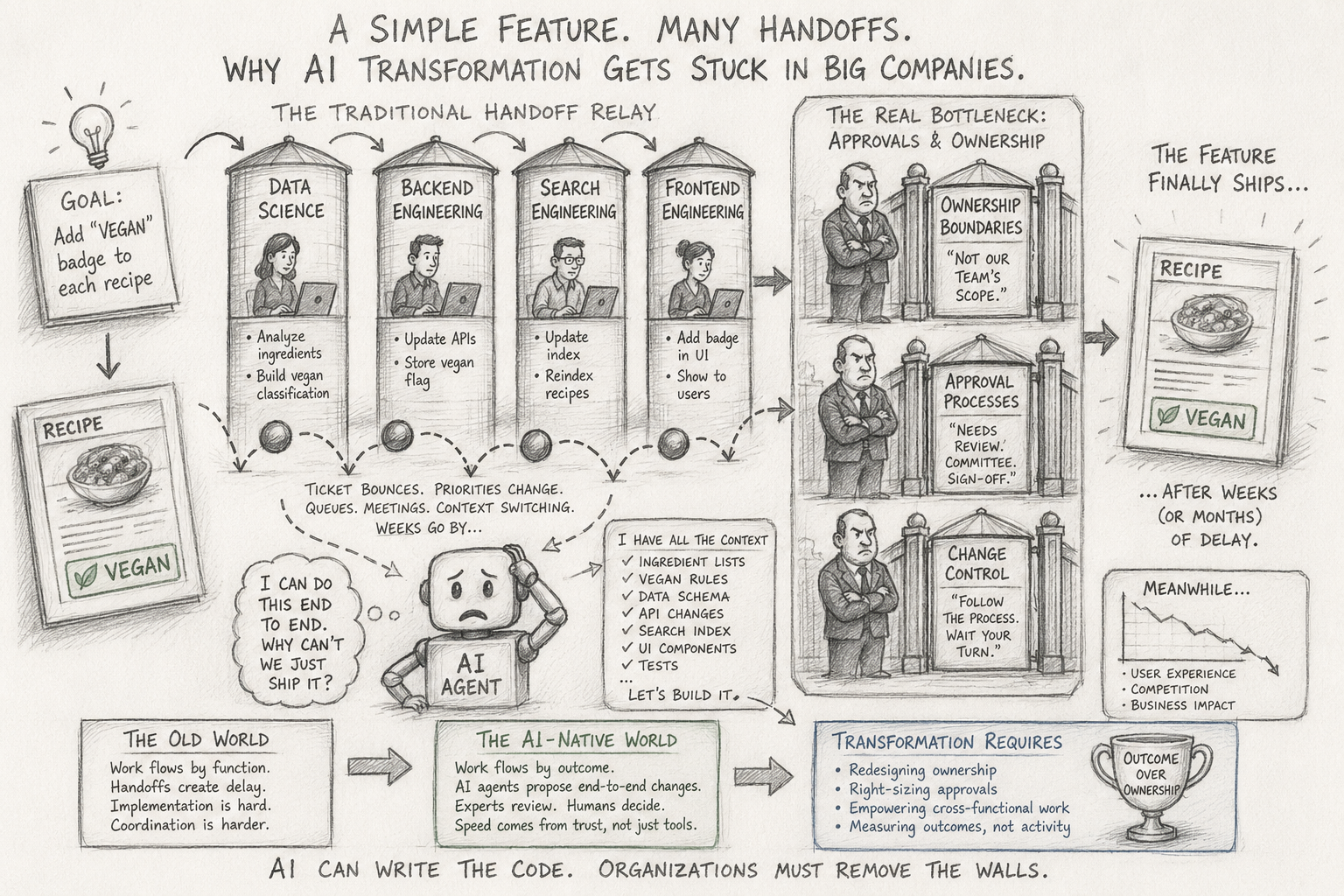
Imagine a recipe website wants to add a Vegan badge to every recipe.
Not a particularly difficult feature.
The ingredients are messy and not normalized, so the request lands with the Data Science team.
The Data Science team develops the classification logic.
The Backend team exposes the new attribute.
The Search team updates the index.
The Frontend team adds the badge to the UI.
A few weeks later, the feature ships.
Now ask yourself a different question.
Could an AI agent complete all of those tasks?
Today?
I think the answer is increasingly yes.
Not perfectly.
Not without review.
But certainly well enough to create a working implementation.
So if the implementation can be done in hours, why does the feature still take weeks?
The Wrong Conversation
Most discussions about AI transformation focus on individual productivity.
How do we make developers faster?
How do we make analysts faster?
How do we make product managers faster?
Those are reasonable questions.
But they miss a bigger issue.
In large organizations, implementation is often not the bottleneck.
Coordination is.
Approvals are.
Handoffs are.
Ownership boundaries are.
A feature that requires four hours of engineering effort and four weeks of coordination still takes four weeks.
AI doesn’t magically remove the coordination.
Capability vs Permission
Historically, specialization made sense.
A data scientist wasn’t expected to modify frontend code.
A frontend engineer wasn’t expected to tune search relevance.
Organizational boundaries reflected technical reality.
AI is changing that reality.
Today, a data scientist with sufficient context can probably make a small UI change.
A frontend engineer can probably contribute to a simple data workflow.
The question is increasingly no longer:
Can they do it?
The question is:
Are they allowed to do it?
That distinction matters.
A lot.
The Uncomfortable Part
This is where AI transformation becomes less about technology and more about organizational design.
Most large companies are built around ownership.
Teams own systems.
Managers own teams.
Directors own budgets.
Entire career paths are built around specialized domains.
AI doesn’t respect those boundaries.
An AI agent doesn’t care whether a change belongs to Data Science, Backend Engineering, Search, or Frontend.
It only sees the objective.
Humans see organizational charts.
That’s where the friction begins.
What Happens Next?
I don’t think the companies that win will necessarily have the best models.
I think they’ll have the shortest distance between an idea and a production change.
That requires more than AI.
It requires rethinking how work moves through an organization.
It requires trusting people to work across traditional boundaries.
It requires shifting humans from implementation to review, governance, and decision-making.
Most importantly, it requires recognizing that many of the processes we built for a pre-AI world may no longer be optimal in an AI world.
Final Thought
If your AI transformation strategy only makes individual contributors faster, you may be optimizing the wrong bottleneck.
AI can already cross technical boundaries.
The real question is whether our organizations can.